





Protect Your Sight This February
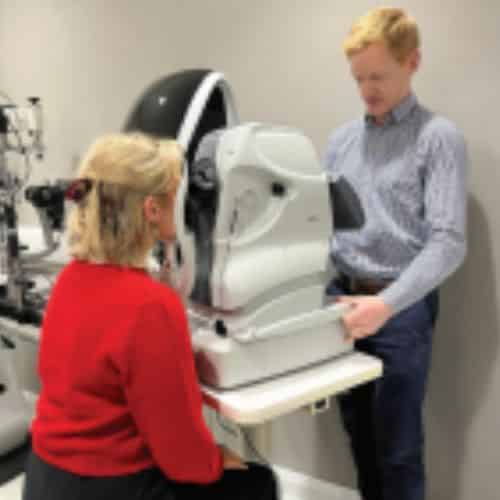
February is Age Related Macular Degeneration and Low Vision Awareness Month. Fairbairn Opticians explains how early detection can help preserve your vision.
From reading your favourite book to recognising a friend’s face across the room, your eyesight shapes how you experience the world. Yet one of the most common causes of vision loss in adults over 50 often develops silently. It’s called Age Related Macular Degeneration, or AMD.
What is AMD
AMD affects the central part of your vision by damaging the macula, the area responsible for sharp, detailed sight. It doesn’t affect your peripheral vision, so you’ll still see objects at the edges of your view, but tasks like reading, cooking, sewing and using your phone can become increasingly difficult.
Women are at slightly higher risk, partly because we tend to live longer. The condition usually develops gradually, which is why awareness and regular eye checks are so important.
The two types of AMD
Dry AMD is the most common form. It develops slowly as natural wear and tear causes waste to build up in the light sensitive cells of your eye. Early symptoms may be subtle, such as slight blurring or difficulty reading.
Wet AMD is less common but more serious. It occurs when abnormal blood vessels grow behind the macula and leak fluid or blood, causing rapid vision loss. With prompt diagnosis, treatment can help preserve your sight.
Warning signs to watch for
- Blurred or distorted central vision
- Straight lines appearing bent
- Difficulty reading or recognising faces
- Needing brighter light for detailed work
- Dark or empty patches in your central vision
If you notice any of these symptoms, contact your optometrist urgently.
Taking control of your eye health
While age and genetics play a role, lifestyle choices can make a real difference.
- Stop smoking — the biggest modifiable risk factor
- Eat well — focus on leafy greens, colourful fruit and oily fish
- Wear sunglasses to protect from UV light
- Stay active to support circulation
- Keep blood pressure and cholesterol under control
- Book regular eye exams — your best protection strategy
Advanced monitoring at Fairbairn Opticians
Modern technology has transformed how AMD is detected and monitored. At Fairbairn Opticians, we use advanced imaging techniques that are quick, painless and highly effective.
OCT imaging (Optical Coherence Tomography) is considered the gold standard for AMD detection. It provides detailed cross sectional images of the retina, allowing us to identify early signs of Dry AMD, detect fluid or swelling linked to Wet AMD, and monitor changes over time.
Optomap imaging captures an ultra wide photograph of your retina to document the macula’s appearance and detect subtle pigment or waste changes. It complements OCT imaging perfectly, giving a full picture of retinal health.
These technologies can detect early changes before you notice any symptoms, offering the best chance to preserve your sight.
The Amsler Grid
The Amsler Grid is also a simple at home monitoring tool many AMD patients use to check for distortion or missing areas in their central vision. You can download one at www.amslergrid.org/AmslerGrid.pdf and report any changes to your optometrist straight away.
Living well with AMD
A diagnosis of AMD can feel worrying, but there is plenty of reason for hope. With modern treatments, low vision aids and practical support, many people maintain their independence and quality of life. Your optometrist can guide you through the options and help you create a care plan that works for you.
This February, give yourself the gift of awareness. Schedule an enhanced eye examination at Fairbairn Opticians and take the first step toward protecting your precious vision.