





The Rise of Regenerative Aesthetics
From polynucleotides and PRP to collagen-stimulating injectables and microneedling, Dr Peter Murphy of Aesthetic Skin Clinic explains why more women are moving away from obvious tweakments and choosing treatments that prioritise skin quality and deliver more natural-looking results.
Why are more patients moving towards regenerative aesthetics?
For years, aesthetic medicine was too often judged by what could be frozen or filled in a single appointment. But according to Dr Peter Murphy, founder and medical director of Aesthetic Skin Clinic, one of the biggest shifts in modern aesthetics has little to do with chasing an obviously “done” look.
“The most sophisticated aesthetic work now is often the least obvious,” he says. “Patients still want results, but they want them to look believable. They want to look fresher. They want to look like themselves, not altered.”
It is a shift he is seeing more and more in clinic, with women asking not for dramatic change, but for better skin, improved texture and subtle support where time has started to show.
Rather than relying solely on traditional filler or anti-wrinkle treatments, many are now turning towards regenerative or bioregenerative aesthetics. Instead of simply adding volume, these treatments focus on improving the quality of the skin and soft tissue itself.
“For me, that is where the most sophisticated aesthetic work now lies,” says Dr Murphy. “Regenerative treatments are about working with the body rather than masking over it. The goal is to stimulate collagen and improve the quality of the tissue. That usually gives a softer, more elegant result.”
Why Skin Quality Now Comes First
One of the clearest examples is the growing popularity of skin boosters and hydration-focused injectables such as Profhilo, Skinvive and NCTF. These are not designed to create volume in the way a traditional filler might. Instead, they improve skin quality and boost hydration, helping skin look fresher and more resilient.
“These treatments can make a real difference to the overall quality of the skin,” says Dr Murphy. “Patients often notice that their skin looks healthier and more refreshed. It is not about changing their face. It is about improving the canvas.”
That idea of “the canvas” is central to the way he treats patients. Rather than reaching straight for volume, he increasingly focuses on skin quality first, and says that approach often leads to better long-term results for women who want to look well rather than obviously treated.
Alongside skin boosters, Dr Murphy is also seeing growing demand for treatments that support repair and regeneration at a deeper level, particularly polynucleotides and PRP.
Polynucleotides are used to support tissue repair and improve skin quality, while PRP, or platelet-rich plasma, uses the patient’s own growth factors to encourage healing and regeneration.
“Polynucleotides and PRP are excellent examples of where aesthetics is heading,” says Dr Murphy. “They are not quick-fix glamour treatments. They are about improving tissue quality and creating better conditions within the skin over time.”
For many women, that gradual improvement is exactly the appeal.
“Many women are actively looking for treatments that do not scream that they have had something done,” he says. “They want the compliments to be, ‘You look well’ or ‘You look fresh’, not ‘What did you have done?’”
That subtlety is a major part of Dr Murphy’s own philosophy. He is known for taking a measured approach, looking at the face as a whole rather than treating one feature in isolation.
The Shift Towards Smarter Treatment Plans
For patients experiencing skin laxity or more noticeable loss of support, Dr Murphy may also incorporate collagen-stimulating injectables such as Sculptra, Juvelook or Lenisna.
“These are treatments where experience and planning really matter,” he says. “Not every patient needs volume. Sometimes what they actually need is collagen stimulation or support in areas where the face has started to change. If you understand that difference, the results tend to look much more natural.”
It is one of the reasons he believes the future of aesthetics lies in combination treatments rather than one-size-fits-all solutions.
A patient with dull or dehydrated skin may benefit most from a skin booster. Another may be better suited to polynucleotides. Someone with more advanced collagen loss may need a biostimulatory treatment such as Sculptra or Juvelook. In many cases, the best results come from a carefully layered treatment plan.
This is where Dr Murphy’s approach stands apart. Rather than treating trends, he works with each woman’s face individually, considering what is changing, what still looks strong, and where treatment will have the most elegant effect. Sometimes that means doing less. Sometimes it means treating in stages. Sometimes it means improving the skin before adding anything else.
Microneedling also continues to play a major role in this regenerative approach.
“Microneedling is still one of the most valuable tools we have for improving skin quality,” says Dr Murphy. “It can be incredibly effective for texture, early ageing changes and acne scarring. Used well, it complements regenerative injectables very naturally.”
His approach is not about replacing every traditional treatment, but about using the right treatment in the right patient, at the right time. Anti-wrinkle injections and filler still have an important place in modern aesthetics. But increasingly, he sees the most elegant results coming from plans that prioritise skin quality first.
In modern aesthetics, the best result is rarely the one that looks “done”. More often, it is the one that simply makes someone look fresher, healthier and more like themselves.
Treatment Results
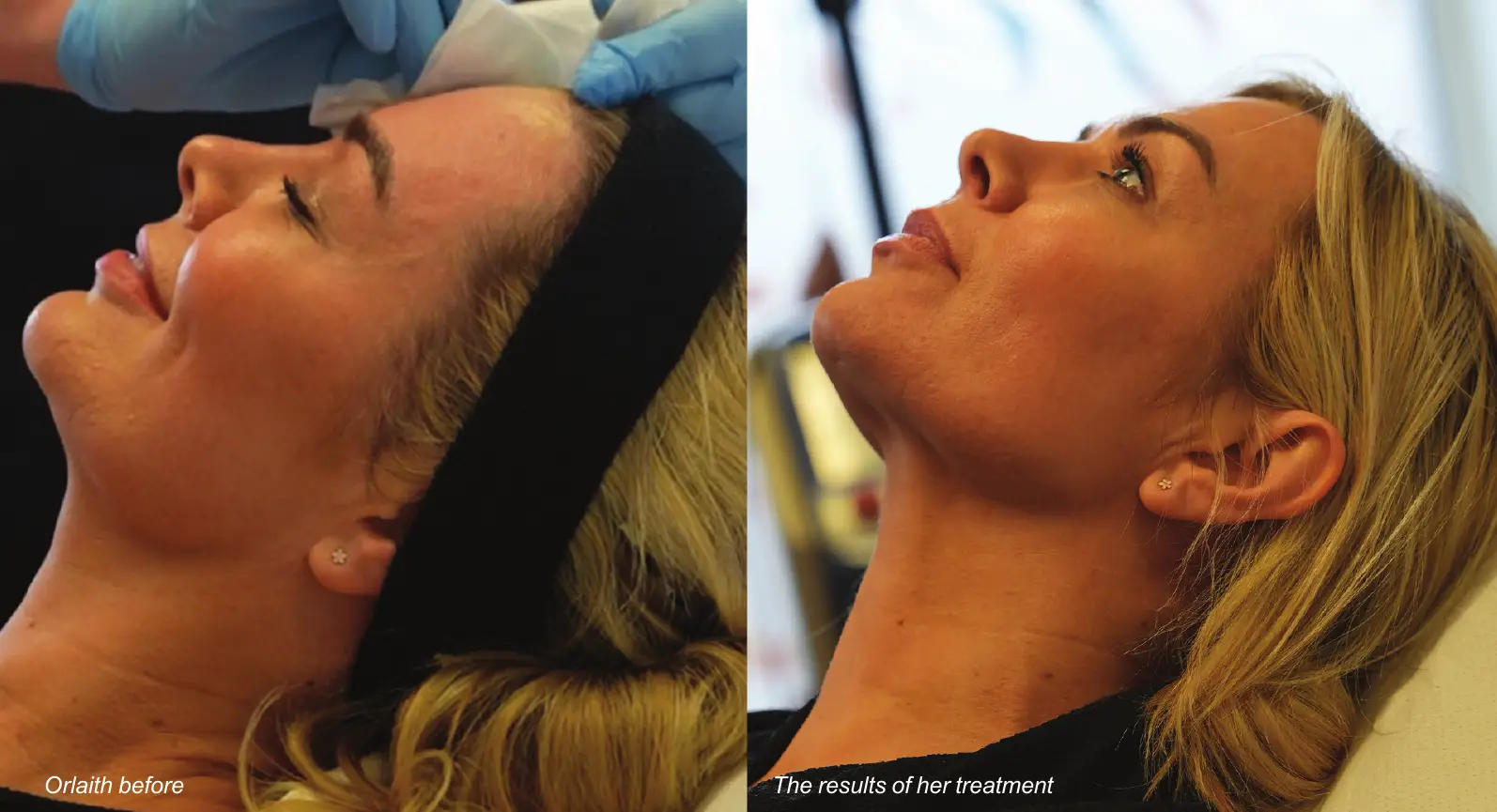
Orlaith pictured one week after a full facial rejuvenation at ASC using the FILLMED range of fillers to enhance and add volume to her temples, cheeks and jawline. The treatment included biostimulation under the eye with Juvelook and the use of Lenisna on the mid face, jaw and neck. The results will continue to settle and improve over the next month and will last for up to 18-24 months.
Contact Details
ASC Belfast
51 Botanic Avenue
Belfast
BT7 1JL
Tel: 028 90 319 060
Instagram: @aestheticsskinclinic
TikTok: @ascbelfast